

Tummy Tuck in Dubai (Abdominoplasty)
A tummy tuck in Dubai restores a flatter, more defined midsection by removing excess skin and tightening weakened abdominal muscles. Whether following pregnancy, significant weight loss, or natural ageing — the resultis a smoother, more proportionate silhouette. Every procedure is planned and performed personally by Dr. Leonard Josipovic at Seline Clinic, Umm Suqeim, Dubai.
What is a Tummy Tuck (Abdominoplasty) in Dubai?
A tummy tuck — clinically known as abdominoplasty — is a surgical body contouring procedure that removes excess skin and fat from the abdominal area while tightening the underlying muscles. It is not a weight loss procedure — it is a reshaping tool for patients who are at or near their ideal weight but have loose, sagging skin or muscle separation that diet and exercise cannot correct. The procedure is one of the most transformative in body contouring surgery. For the right patient, a tummy tuck delivers permanent, natural-looking results that restore confidence and proportion.
You may be a good candidate if you:
- Have excess skin or fat on the abdomen that does not respond to diet or exercise
- Have muscle separation (diastasis recti) following pregnancy.
- Have lost significant weight and are left with loose, overhanging abdominal skin.
- Are at a stable weight and not planning pregnancy in the near future.
- Are a non-smoker or willing to stop at least 4 weeks before surgery.
- Are in good general health and able to undergo general anaesthesia
The best way to confirm candidacy is a personal consultation with Dr. Leonard. He will assess your anatomy honestly and advise whether a tummy tuck, liposuction, or a combination approach is the right path for you.
types of Tummy Tuck in dubai
Standard Abdominoplasty
A standard, or full, abdominoplasty is the most commonly performed tummy tuck procedure. It addresses the entire abdominal area, from the pubic region to the rib cage. Dr. Leonard creates a carefully planned incision from hip to hip, through which excess skin and fat are removed and the underlying abdominal muscles are tightened and reinforced. The incision is positioned
low along the bikini line to allow the scar to remain discreet and easily concealed. In most cases, the navel is repositioned or reconstructed to maintain natural proportions, which may result in a small scar around the belly button.
Mini Abdominoplasty
A mini abdominoplasty is suitable for patients with mild skin laxity and excess tissue limited to the area below the belly button. During this procedure, Dr. Leonard removes excess skin and fat from the lower abdomen, making it particularly effective for addressing localised fullness or skin overhang above the pubic area. The incision is shorter and similar in placement to a Caesarean section scar. Because the procedure is less extensive, recovery time is typically shorter than with a full abdominoplasty.low along the bikini line to allow the scar to remain discreet and easily concealed. In most cases, the navel is repositioned or reconstructed to maintain natural proportions, which may result in a small scar around the belly button.
Endoscopic Abdominoplasty
Endoscopic abdominoplasty is a minimally invasive option designed primarily to tighten and repair the abdominal muscles
rather than remove significant excess skin. Through small, discreet incisions, Dr. Leonard inserts a tiny camera connected to a flexible tube, allowing precise visualisation of the abdominal wall. Specialised surgical instruments are then used to correct muscle
separation and strengthen the abdominal structure, resulting in improved contour with minimal scarring.
Tummy Tuck Combined with Liposuction in Dubai
Abdominoplasty is performed under general anaesthesia with a consultant anaesthetist present throughout the procedure. Operative time typically ranges from two to five hours, depending on the surgical technique selected and whether adjunct liposuction is performed. Most patients remain in hospital for one to two nights to allow for appropriate monitoring, pain management, and early mobilisation.
A low, horizontal incision is carefully planned within the pubic region. Its length and exact positioning are determined by the amount of excess skin and the individual abdominal anatomy. Dr. Leonard designs the incision to sit discreetly beneath standard underwear and swimwear, with an emphasis on symmetry and a low-profile scar.
Closed-suction drains may be placed during surgery and are usually retained for up to one week, depending on output and intraoperative assessment. A medical-grade compression garment is worn for approximately six weeks to support healing, reduce swelling, and optimise the final contour.
Postoperative bruising and swelling typically improve within the first six weeks, with further refinement continuing over several months. Light activity, such as walking, is generally encouraged from two to three weeks, while heavy lifting and strenuous exercise should be avoided for up to eight weeks, or until cleared during follow-up appointments.
What to Expect — Tummy Tuck in Dubai
Before
Your journey begins with a personal consultation with Dr. Leonard. He will assess your abdominal skin laxity, muscle tone, fat distribution, and surgical history before recommending the most appropriate technique. Pre-operative instructions include
stopping smoking at least 4 weeks before surgery, avoiding blood-thinning medications, and arranging support for the first 48 hours post-operatively.
During
Abdominoplasty is performed under general anaesthesia with a consultant anaesthetist present throughout. Operative time typically ranges from two to five hours depending on the technique selected and whether liposuction is performed. A low, horizontal incision is carefully planned within the pubic region — designed to sit discreetly beneath standard underwear and swimwear. Most patients remain in hospital for one to two nights.
After
A medical-grade compression garment is worn for approximately six weeks to support healing and optimise final contour. Closed-suction drains may be placed and are typically removed within
one week. Light activity such as walking is encouraged from two to three weeks. Heavy lifting and strenuous exercise should be avoided for up to eight weeks. Final results become fully visible as swelling resolves — typically over three to six months.
Recovery timeline for tummy tuck in dubai
Timeframe
What to Expect
Day 1–3
Tightness, swelling, mild to moderate discomfort. Rest advised. Compression garment worn continuously. Drains in place.
Day 4–7
Comfort improves. Light movement around the home encouraged.Drains typically removed.
Week 2
Most patients return to desk work. Surgical garment continues.Short walks encouraged.
Week 4–6
Swelling reducing. Garment continues. Bruising largely resolved.
Week 6+
Exercise and physical activity cleared by Dr. Leonard at follow-up appointment.
Month 3-6
Final results fully visible as all residual swelling resolves
and scar continues to mature.
Why Patients Choose Dr. Leonard for tummy tuck in Dubai
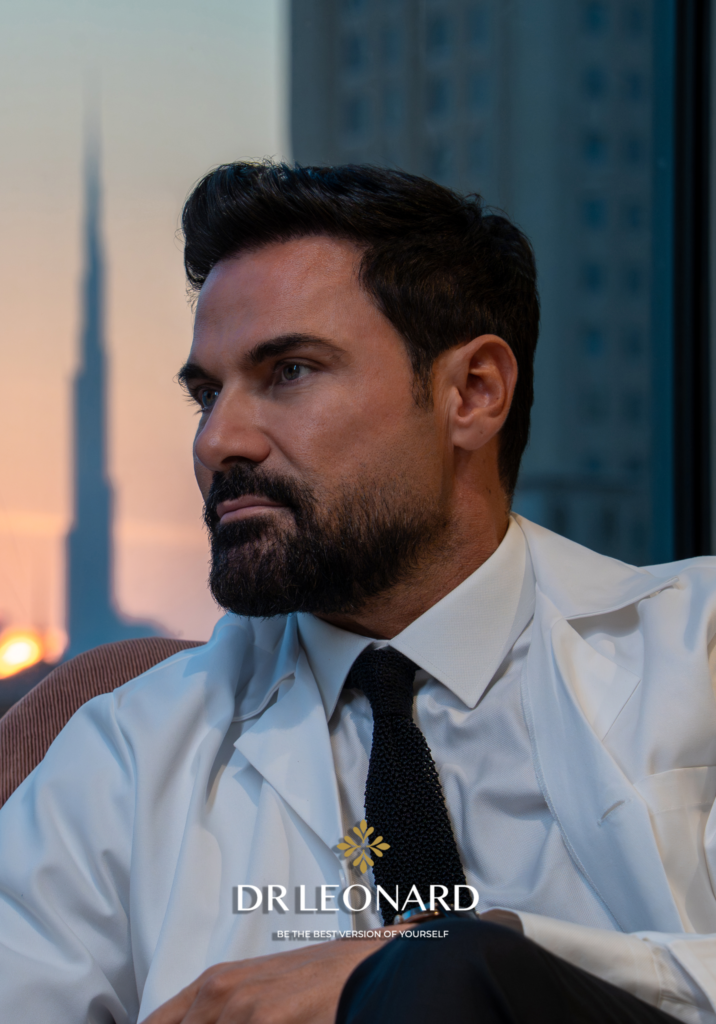
A tummy tuck is one of the most technically demanding procedures in body contouring surgery. The quality of the result depends entirely on surgical judgment, incision planning, and an eye for proportion. Dr. Leonard brings all three — with specialist training in body contouring surgery across two continents and a personal commitment to performing every procedure himself.
Board-Certified Plastic Surgeon
Certified by the German Board of Plastic and Aesthetic Surgery — one of the most rigorous certification standards in Europe.
Trained at World-Leading Institutions
Medical education at Goethe University Frankfurt with internships at UCLA and Imperial College London.
Rosenpark Klinik
Dr. Leonard trained and operated as a Consultant Plastic Surgeon at Rosenpark Klinik in Germany — internationally renowned for body contouring excellence.
Seline Clinic & Mubadala Health Dubai
Dr. Leonard performs tummy tuck procedures at Seline Clinic, Umm Suqeim,
and Mubadala Health Dubai — part of the Cleveland Clinic Abu Dhabi network. Your surgical location will be confirmed at consultation.
Frequently Asked Questions — tummy tuck in Dubai
Everything you need to know before booking your consultation.
What is the difference between a tummy tuck and liposuction?
Liposuction removes fat but does not address loose skin or muscle separation. A tummy tuck removes excess skin,
tightens muscles, and may include liposuction for enhanced contouring. If loose skin is the primary concern, a tummy tuck is typically the more appropriate procedure.
Can a tummy tuck be combined with other procedures?
Yes — a tummy tuck is most commonly combined with liposuction for comprehensive body contouring, or
as part of a mommy makeover alongside breast surgery. Dr. Leonard will advise on what can be safely combined during a single procedure.
Will a tummy tuck remove stretch marks?
A tummy tuck can remove stretch marks located on the skin that is excised during surgery — typically those on the lower abdomen. Stretch marks above the navel may be partially improved as the skin is repositioned but cannot be fully removed.
How long does tummy tuck recovery take in Dubai?
Most patients return to light daily activity within two to three weeks and desk work within two weeks. Exercise and heavy lifting should be avoided for up to eight weeks. Final results are typically visible within three to six months as swelling resolves.
Will there be visible scarring?
A tummy tuck involves a horizontal incision across the lower abdomen. Dr. Leonard carefully plans incision
placement to sit within the natural bikini line — discreet and easily concealed beneath underwear and swimwear. Scars typically fade significantly over 12 to 18 months.
How do I know if I need a mini or full tummy tuck?
This is assessed during consultation based on the amount of excess skin, degree of muscle separation, and your
aesthetic goals. A mini tummy tuck suits patients with mild skin laxity limited to the lower abdomen. A full abdominoplasty is appropriate when there is significant excess skin across the entire abdominal area.
Can I have a tummy tuck after a C-section?
Yes — many patients undergo abdominoplasty following one or more caesarean sections. Dr. Leonard takes the existing scar into consideration when planning the incision to minimise additional scarring where possible.
Is a tummy tuck safe in Dubai?
Abdominoplasty performed by a board-certified plastic surgeon in a DHA-licensed facility is a well-established, safe procedure. Dr. Leonard operates within fully regulated environments at Seline Clinic and Mubadala Health Dubai with complete pre and post-operative care protocols in place.
How much does a tummy tuck cost in Dubai?
The cost of a tummy tuck in Dubai varies depending on the technique selected, whether liposuction is combined, and the complexity of each individual case. Dr. Leonard provides a personalised cost breakdown during consultation — after assessing your anatomy and treatment goals.